How Long Should You Walk a Puppy? Exercise Chart by Age
PawSmart is reader-supported. When you buy through links on our site, we may earn an affiliate commission at no extra cost to you. This never affects our recommendations.
How we research. PawSmart is independent and reader-supported. For guidance like this we work from peer-reviewed veterinary research, published guidance from veterinary and kennel-club bodies, and the consensus of qualified professionals — and where the evidence is thin or conflicting, we say so plainly rather than pretending there's a settled answer.
Ask five people how far to walk a puppy and you'll get five answers. The most repeated one is the "five-minute rule" — five minutes of walking per month of age, twice a day. It's a useful starting point, and we've charted it below. But it's worth knowing where that rule came from, what the research does and doesn't support, and why the type of exercise your puppy gets probably matters more than the number of minutes.
The five-minute rule, charted
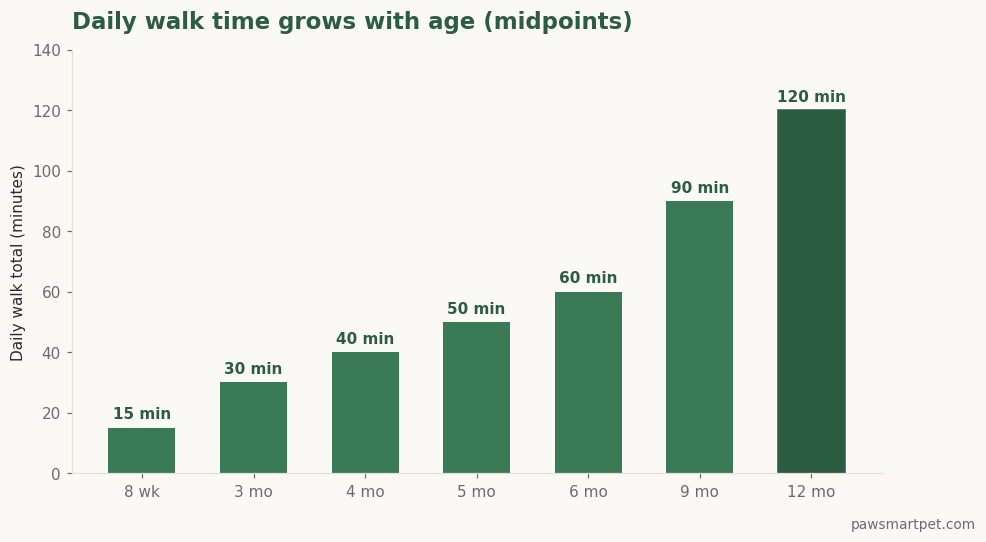
The rule of thumb: five minutes of formal, on-leash walking per month of age, up to twice a day. A four-month-old puppy gets up to 20 minutes, twice daily. Here's what that looks like across the first year.
| Puppy age | Walk length (per walk) | Walks per day | Daily total |
|---|---|---|---|
| 8 weeks (2 months) | ~10 minutes | 1–2 | 10–20 minutes |
| 3 months | ~15 minutes | 2 | ~30 minutes |
| 4 months | ~20 minutes | 2 | ~40 minutes |
| 5 months | ~25 minutes | 2 | ~50 minutes |
| 6 months | ~30 minutes | 2 | ~60 minutes |
| 9 months | ~45 minutes | 2 | ~90 minutes |
| 12 months | ~60 minutes | 2 | ~2 hours |
Note that this is a ceiling for structured lead walks, not a target your puppy must hit. A young puppy that would rather sniff one hedge for ten minutes is doing exactly the right thing.
Where the rule came from — and what the evidence says
Here's the part most articles skip: the five-minute rule has never been tested directly in a study. It's long-standing guidance, widely repeated by kennel clubs and vets because it's easy to remember and errs on the side of caution. That doesn't make it wrong — but it does mean it's a sensible convention rather than a scientific finding, and you shouldn't treat the numbers above as a hard biological limit.
What has been studied is the kind of activity puppies do. A prospective Norwegian cohort study following 501 dogs across four large breeds (Krontveit and colleagues, American Journal of Veterinary Research, 2012) found two things worth knowing:
- Stairs before 3 months of age were associated with a higher risk of hip dysplasia. Repeatedly climbing steps in the first twelve weeks is the one thing the data flags most clearly. Carry small puppies up and down stairs.
- off-leash exercise on soft, gently uneven ground was protective. Puppies allowed to potter about off-leash in parkland had a lower risk of hip dysplasia than those who weren't.
So the honest summary is this: the risk isn't "movement." The risk is repetitive, forced, high-impact movement on hard surfaces — and the fix isn't to keep your puppy still, it's to let them move freely on forgiving ground.
What counts toward the limit (and what doesn't)
The five-minute cap applies to structured lead walking — you setting the pace on pavement. It is not a budget for your puppy's entire day. These generally don't count against it:
- Free play in the garden at your puppy's own pace, with the freedom to stop.
- Sniffing and exploring — mentally tiring, physically gentle, and genuinely good for them.
- Gentle off-leash mooching on grass with age-matched playmates.
- Short training sessions, which tire a puppy out far more efficiently than distance.
- Swimming in shallow, calm, safe water.
And these deserve real caution while growth plates are still open:
- Stairs, especially under 3 months.
- Repetitive fetch with hard stops, skids and twists.
- Jumping down from sofas, beds, car boots. A ramp solves this cheaply.
- Running on pavement, and jogging or cycling alongside you — save these until skeletally mature.
- Slippery floors. Rugs and runners are an underrated investment.
Adjust for your puppy's size
Growth plates close at different ages. Small breeds finish growing at around 9–12 months; large and giant breeds may not be skeletally mature until 18–24 months. A Great Dane puppy therefore needs the cautious approach for far longer than a Jack Russell does. When in doubt, ask your vet when your specific dog is likely to be done growing.
Signs your puppy has done too much
- Lagging behind, sitting down, or refusing to walk on the way home
- Limping, or stiffness when getting up after a nap
- Sleeping much more heavily than usual, or being sore to the touch
- Getting wired and bitey rather than settling — over-tired puppies look hyperactive, not sleepy. If that sounds familiar, see why puppies get hyper at night.
Any limping that lasts more than a few minutes, or that comes back, is a reason to call your vet rather than to rest and hope.
Making walks easier while you build up
Short walks are the time to teach lead manners, before your puppy is strong enough to drag you. A well-fitted harness stops pressure on a developing neck and takes the fight out of pulling — see our picks for the best no-pull harnesses, and our guide to leash training a puppy. If your puppy isn't fully vaccinated yet, read when puppies can safely go outside first — carrying them out to watch the world is real socialization, and it costs zero minutes of walking.
Frequently asked questions
How long should I walk a 3-month-old puppy?
Using the five-minute rule, roughly 15 minutes of structured lead walking per session, up to twice a day. Treat that as a ceiling rather than a target — plenty of three-month-old puppies are happy with less, and free sniffing and pottering in the garden is worth more to them than distance. Free play at their own pace doesn't count against the limit.
Is the five-minute rule actually backed by science?
Not directly. It's a widely repeated, sensibly cautious rule of thumb rather than the finding of a specific study. What research does show, from a Norwegian cohort study of 501 large-breed dogs published in 2012, is that stair climbing before three months of age was linked to higher hip dysplasia risk, while off-leash exercise on soft, moderately uneven ground was protective. The type and surface of exercise appears to matter more than the exact number of minutes.
Can I over-exercise my puppy?
Yes, but the risk comes mainly from repetitive high-impact activity on hard surfaces while the growth plates are still open — long pavement runs, stairs, repeated fetch with hard stops and turns, and jumping down from height. Free, self-directed movement on grass is not the problem and may actively help joint development. Watch for limping, stiffness after rest, or reluctance to keep walking.
When can my puppy go running or jogging with me?
Wait until your puppy is skeletally mature, which means growth plates have closed. That's roughly 9–12 months in small breeds and can be 18–24 months in large and giant breeds. Ask your vet about your individual dog, because breed size changes the answer a lot. Starting sustained road running too early loads joints that are still developing.
Should I carry my puppy up and down stairs?
For the first three months, yes, if you can safely lift them. Stair use from birth to three months of age was the exercise factor most clearly associated with increased hip dysplasia risk in the Krontveit study. After that, occasional careful stair use is generally fine for most puppies, but avoid making steep stairs part of a daily routine while your puppy is still growing.
⚕️ A note on advice: This article is general guidance to help you make informed decisions — it is not a substitute for professional veterinary advice. If your puppy is limping, reluctant to walk, or seems sore after exercise, stop and speak to your vet before continuing.
Trusted resources for further reading
AKC — Expert Advice ASPCA — General Dog Care AVMA — Pet Care Basics
