How Long Can a Puppy Hold It? Bladder Control Chart by Age
PawSmart is reader-supported. When you buy through links on our site, we may earn an affiliate commission at no extra cost to you. This never affects our recommendations.
How we research. PawSmart is independent and reader-supported. For guidance like this we work from peer-reviewed veterinary research, published guidance from veterinary and kennel-club bodies, and the consensus of qualified professionals — and where the evidence is thin or conflicting, we say so plainly rather than pretending there's a settled answer.
Every new owner asks the same question at about 2am: how long can this puppy actually hold it? The widely used rule of thumb is a puppy's age in months, plus one, in hours. It's a decent guide during the day and an optimistic one at night. Here's the chart, plus the things the chart doesn't tell you.
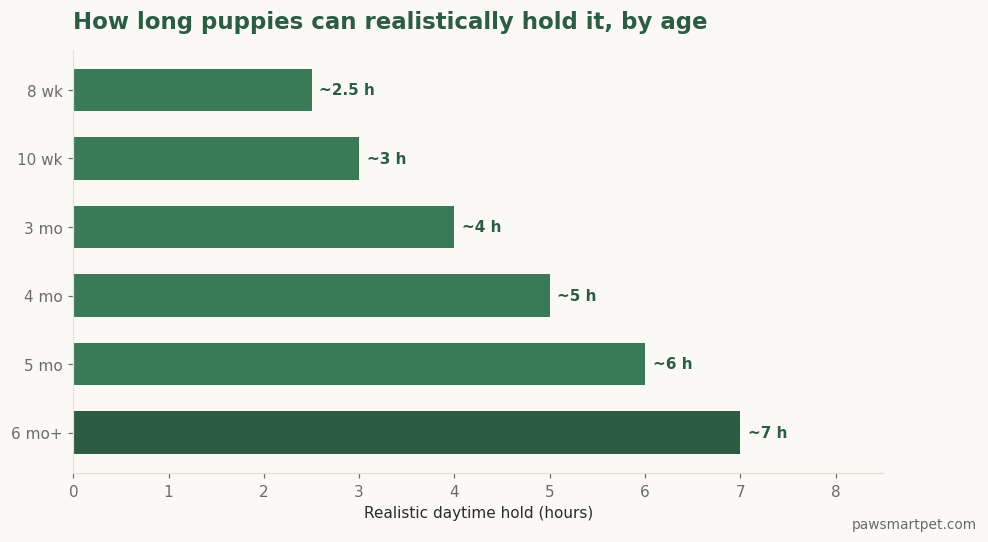
Puppy bladder control chart by age
The month-plus-one rule: a two-month-old puppy can hold it for roughly three hours, a three-month-old for four, and so on. Treat these as maximums under calm conditions, not schedules to aim for.
| Puppy age | Realistic daytime hold | Take out every |
|---|---|---|
| 8 weeks (2 months) | up to ~2–3 hours | 1–2 hours, and after every nap, meal and play session |
| 10 weeks | ~3 hours | 2 hours |
| 3 months | ~4 hours | 2–3 hours |
| 4 months | ~5 hours | 3–4 hours |
| 5 months | ~6 hours | 4 hours |
| 6 months and older | ~6–8 hours | 4–6 hours |
Two important caveats. First, "can hold it" is not "should be made to." Even an adult dog able to last eight hours shouldn't routinely be asked to. Second, most puppies don't have full, reliable voluntary bladder control until somewhere around six or seven months, no matter how well the chart says they should be doing.
What resets the clock
The chart assumes a resting puppy. In practice, the bladder empties on a schedule driven by events, not hours. Take your puppy out immediately:
- The moment they wake up, from a nap or overnight
- Within 5–15 minutes after eating or drinking
- After any burst of play or excitement
- Before and after being in the crate
- Any time you see the tell — sniffing in circles, sudden distraction, drifting toward a door or a rug
Overnight is different
Puppies sleep deeply, drink nothing overnight and move very little, so they can usually last a bit longer at night than the daytime chart suggests. Even so, expect an eight-week-old to need one or two trips out during the night, and plan for it rather than resent it. Most puppies begin sleeping through the night somewhere between 12 and 16 weeks.
What helps: pick up the water bowl an hour or two before bed (not all evening — never restrict water beyond that), take a final trip out immediately before lights-out, keep night-time potty trips boring, dark and silent so you're not accidentally teaching your puppy that 3am is party hour, and place the crate close enough that you can hear an early "I need to go" whine before it becomes an accident. If the crying is the bigger problem, read how to stop a puppy crying at night.
How this shapes crate time
A crate works because puppies avoid soiling where they sleep — but that instinct has limits, and a puppy left too long will be forced to break it, which sets your house-training back. Never crate a puppy longer than they can comfortably hold it. A useful ceiling is the age-plus-one figure, capped at around four hours during the day regardless of age, because a young puppy also needs to stretch, drink and be with you.
Sizing matters too: a crate so large the puppy can toilet in one end and sleep in the other removes the whole mechanism. Use a divider and grow the space with them — our guide to the best puppy crates covers sizing, and how to crate train a puppy covers the introduction.
If you work away from home
A young puppy cannot be left alone for a working day. There's no technique that fixes this — the bladder simply isn't ready. Realistic options are a midday visit from a neighbor, friend, dog walker or sitter, a puppy daycare, working from home during the first weeks, or a safely puppy-proofed pen with a toileting area at one end. That last option keeps your floors intact but does slow house-training, because it teaches your puppy that indoor toileting is sometimes permitted.
When accidents mean something medical
House-training accidents are normal. These are not, and warrant a vet visit — the Merck Veterinary Manual lists frequent urination, straining or painful urination, blood in the urine and urinating in unusual places as classic signs of a urinary tract infection, which is treatable but won't fix itself:
- Straining, or squatting repeatedly and producing only a few drops
- Blood in the urine, or a strong change in smell or color
- Drinking noticeably more than usual, and urinating far more
- A puppy who was reliably trained and suddenly isn't
- Dribbling urine while asleep or lying down
Urinary tract infections are common in puppies, especially young females, and are straightforward to treat. Sudden regression after real reliability is a medical question first and a training question second.
Speeding things up
Frequency beats correction. Take the puppy out more often than you think is necessary, reward the instant they finish outdoors rather than when they come back in, and clean indoor accidents with an enzymatic cleaner so no scent marker remains to invite a repeat. Never punish an accident — you'll teach your puppy to hide from you rather than to hold it. The full method is in our puppy potty training guide.
Frequently asked questions
How long can an 8-week-old puppy hold its bladder?
Realistically about two to three hours while awake and calm, and often less after eating, drinking, napping or playing. Plan to take an eight-week-old puppy out roughly every one to two hours during the day, plus immediately after every nap and meal. Overnight they can usually stretch a little longer but will still typically need one or two trips out.
What is the month-plus-one rule for puppies?
It's the common guideline that a puppy can hold its bladder for about its age in months plus one, measured in hours. A three-month-old puppy manages roughly four hours. It's a reasonable ceiling under calm, resting conditions rather than a schedule to aim for, and most puppies don't have full voluntary bladder control until around six or seven months old.
When will my puppy sleep through the night without a potty break?
Most puppies start making it through the night somewhere between 12 and 16 weeks of age. Before that, expect one or two night trips. Lifting the water bowl an hour or two before bed, a final toilet trip right before lights out, and keeping night-time trips silent and boring all help the transition along.
How long can I leave my puppy in a crate?
Never longer than the puppy can comfortably hold it, and as a practical ceiling, no more than about four hours during the day regardless of age. A crated puppy forced to soil its bed loses the instinct that makes crate training work, and sets house-training back. Young puppies also need to stretch, drink and spend time with you, so long crating isn't only a bladder question.
My house-trained puppy suddenly started having accidents. Why?
Sudden regression after genuine reliability should be treated as a medical question first. Urinary tract infections are common in puppies and easily treated, and other causes include bladder stones and, less often, hormonal or anatomical problems. Book a vet check, especially if you see straining, blood, only a few drops at a time, increased drinking, or urine dribbling during sleep.
⚕️ A note on advice: This article is general guidance to help you make informed decisions — it is not a substitute for professional veterinary advice. If your puppy is straining to urinate, producing only drops, urinating blood, or suddenly having accidents after being reliably trained, see your vet — urinary tract infections are common in puppies and easily treated.
Trusted resources for further reading
AKC — Expert Advice ASPCA — General Dog Care AVMA — Pet Care Basics
