How Hot Is Too Hot to Walk a Dog? The Pavement Rule, Examined
PawSmart is reader-supported. When you buy through links on our site, we may earn an affiliate commission at no extra cost to you. This never affects our recommendations.
How we research. PawSmart is independent and reader-supported. For safety guidance like this we work from veterinary and veterinary-school sources, the published burn and pavement-temperature research those sources rely on, and manufacturer specifications for any product we name — and where a widely-repeated "rule" turns out to rest on thin or borrowed evidence, we say so plainly instead of passing it off as settled science.
Every heat wave, the same two rules make the rounds: press the back of your hand to the pavement for seven seconds, and check the chart that says 77°F air means 125°F asphalt. Both are worth knowing. Both are also repeated with a confidence the underlying evidence doesn't quite earn — the numbers come from research on human skin and hot sidewalks, not from any study of dogs' paws. Here's what actually holds up, what's an educated guess, and how to keep your dog safe on a hot day without overthinking it.
The short answer
There is no magic temperature that flips a walk from safe to dangerous, because the air reading is only part of what your dog's paws and body actually experience. That said, a practical starting point most vets would recognize looks like this:
- Below about 68°F (20°C): fine for nearly all dogs.
- Roughly 77–86°F (25–30°C): use judgment — shorten walks, favor shade and grass, avoid midday, and watch flat-faced, old, overweight and thick-coated dogs closely.
- 87°F (31°C) and up: risky for most dogs during the sunny hours. Walk at dawn or after dark, or skip the walk and enrich indoors instead.
Then, whatever the thermometer says, do the one test that matters at ground level: press the back of your hand flat against the pavement and hold it for seven seconds. If you can't keep it there in comfort, the surface is too hot for your dog — turn back or find grass.
The 7-second rule: useful, but not a law of physics
The hand test is genuinely good advice, and it comes from a credible place. Washington State University's College of Veterinary Medicine puts it plainly: if you can't hold the back of your hand on the pavement for a full seven seconds, it's too hot for a pet's paws. The logic is sound — the back of your hand feels damaging heat at roughly the temperature that damages a paw pad, so it's a fair proxy you always have with you.
What you should know is that the "seven seconds" was never established by a controlled study on dogs. It's a sensible convention, not a measured threshold, which is why you'll also see the same advice given as a five-second rule. Dog paw pads are thick, keratinized and tougher than the skin on your hand, so a pad may tolerate a little more than your hand does — but "a little more" isn't a number anyone has pinned down, and pads are far from fireproof. The honest way to use the test is as a quick way to catch clearly dangerous pavement, not as a precise green light.
Where the pavement-temperature numbers come from
That chart you've seen — air temperature in one column, much higher asphalt temperature in the next — is real data, but it's older and narrower than its constant re-sharing suggests. The specific figures below trace to Dr. James Berens' work on thermal contact burns, published in the Journal of the American Medical Association in 1970 and still cited by veterinary schools today:
| Air temperature | Asphalt in direct sun | What it means for paws |
|---|---|---|
| 77°F (25°C) | 125°F (52°C) | The commonly cited threshold — human skin can be destroyed in about 60 seconds at this surface temperature |
| 86°F (30°C) | 135°F (57°C) | Too hot to hold comfortably; paw burns possible with brief contact |
| 87°F (31°C) | 143°F (62°C) | Dangerous — hot enough to blister pads in under a minute |
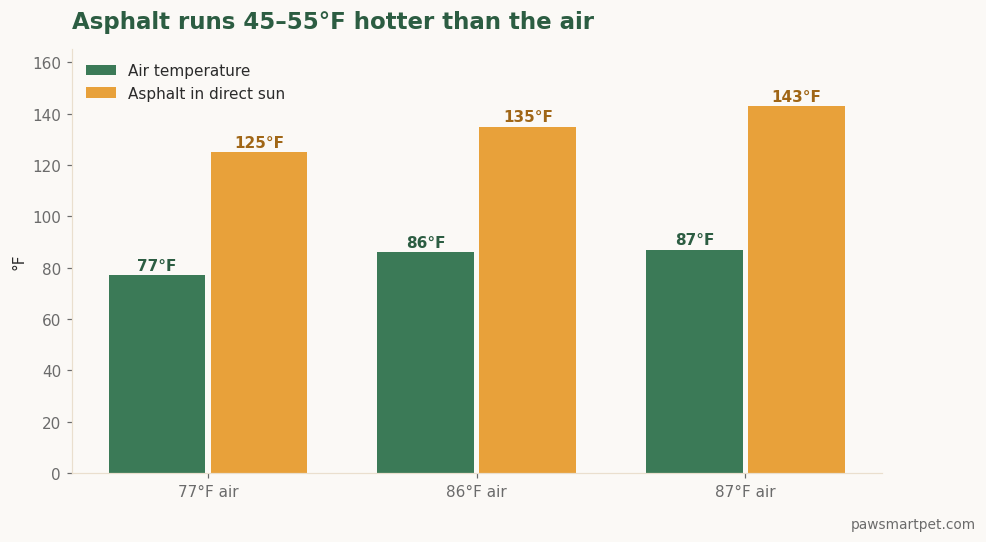
Look closely at the last two rows: a single degree of air temperature, 86°F to 87°F, supposedly swings the surface a full 8°F. That's your tell that the surface temperature depends on far more than the air. Sun angle, cloud cover, wind, how long the sun has been beating down, and the surface material itself all move that number more than the thermometer reading does. The chart is a useful illustration of one point — dark pavement gets shockingly hotter than the air — not a lookup table you should trust to the degree.
What the burn figures actually rest on
The scary numbers attached to those surface temperatures also come from people, not dogs. The classic finding that skin can be destroyed in about 60 seconds at 125°F comes from human-skin burn research — the foundational work is Moritz and Henriques (1947), which mapped how contact time and surface temperature combine to cause burns. A 1995 report from first responders in Maricopa County, Arizona, found summer pavement there was hot enough to cause second-degree burns on human skin within about 35 seconds of contact during the middle of the day.
None of that studied a dog's paw. It's applied to dogs by analogy, and the analogy is reasonable — heat that destroys human skin in a minute is obviously bad news for a paw — but it means the precise thresholds are borrowed, not canine-specific. The useful takeaway survives the caveat intact: hot asphalt burns living tissue fast, so you don't want your dog standing on it. You just shouldn't imagine the "125°F / 60 seconds" figure is a measurement of dogs.
What the chart leaves out (and why your dog may be at more risk)
Paw burns are only one summer hazard, and the air-temperature chart ignores the things that most change your individual dog's risk:
- The surface, not just the sky. Black asphalt is worst. Light concrete runs cooler but still burns in strong sun. Artificial turf, sand, metal truck beds and pool decking can be hotter than asphalt. Grass and shaded dirt stay far cooler — often 30–50°F below an adjacent sidewalk.
- Humidity. Dogs shed heat mainly by panting, which works poorly in humid air. A muggy 82°F day can stress a dog more than a dry 90°F one.
- Breed and build. Flat-faced (brachycephalic) breeds like Bulldogs, Pugs and French Bulldogs overheat dangerously fast. Thick double coats, dark coats, large body size, obesity and old age all reduce a dog's ability to cope.
- Fitness and acclimatization. A dog used to the heat handles it better than one that's spent the summer in air conditioning. Early-season hot days are riskier than late-season ones at the same temperature.
- Time on the surface. A dog crossing a hot street briefly is different from one made to sit, heel or wait on it. Burns build with contact time.
Heatstroke is the bigger killer
Burned pads are painful and worth preventing, but heatstroke is what actually kills dogs in summer, and it comes on faster than most owners expect. Learn the early signs: frantic or heavy panting, bright red gums and tongue, thick drool, wobbliness, confusion, vomiting or diarrhea, and collapse. If you see these, get the dog into shade, offer cool (not ice-cold) water, wet the belly and paws with cool water, and head to a vet immediately — heatstroke is a true emergency.
The single most important rule needs no chart: never leave a dog in a parked car, even for a few minutes with the windows cracked. Interiors reach lethal temperatures within minutes. For the full summer toolkit — vests, mats and what's worth buying — see our guide to dog cooling gear, and for pale or thin-coated dogs, our guide to dog sunscreen.
If you do need to protect the paws
The best protection is free: walk when it's cool, choose grass over asphalt, and turn back when the hand test fails. But if your dog genuinely has to cross hot surfaces — a city dog with no grass nearby, a working dog, a midday bathroom break — boots or paw wax are a reasonable backup. Treat them as insurance, not a license to walk on pavement that would otherwise burn.
Ruffwear Grip Trex Dog Boots
The boots most owners and reviewers keep coming back to. A genuine rubber sole with real tread protects against hot and rough ground, the breathable mesh upper doesn't cook your dog's foot the way a fully sealed boot can, and they're built to take hundreds of miles. Sold in pairs, so you'll need two sets for four paws. The honest drawbacks: they're not cheap, sizing has to be measured carefully, and even fitted well they can rotate or slide down on some dogs until you dial in the Velcro. Nearly every dog also needs a few short indoor sessions to accept them.
Check Price →QUMY Dog Boots
A far cheaper way to find out whether your dog will tolerate boots at all. They have a rugged anti-slip sole, a wide split seam with two reflective straps that makes them easier to get on than most, and they come as a set of four. They work, but the durability is what you'd expect at the price: owners report the straps and seams wearing after steady use, and fit runs inconsistent between sizes, so measure and be ready to size up or down. Good as a starter or backup pair rather than a boot for daily hard miles.
Check Price →Musher's Secret Paw Wax
If your dog flatly rejects boots, this beeswax-based balm rubs onto the pads and forms a breathable, moisturizing barrier that helps against rough and abrasive ground. Be clear-eyed about what it is, though: it is not a heat shield. On pavement genuinely hot enough to burn, the wax offers little real protection and can soften in the heat. Use it for grip, dryness and minor abrasion, and to condition pads — not as a reason to walk on asphalt that fails the hand test.
Check Price →Paws are one hazard; overheating is the deadlier one. Cooling gear does more to prevent summer emergencies than any boot.
See our dog cooling gear guide →If you think the pavement burned your dog's paws
Burns can take hours to show fully, so act on suspicion. The early signs are limping, suddenly refusing to walk, and licking or chewing at the feet. Check the pads for redness, darkened or missing patches, blisters, or a surface that looks like it's peeling.
- Get off the hot surface and onto grass, shade or indoors immediately.
- Cool the paws with cool (not ice-cold) water for several minutes to draw out the heat.
- Don't pop blisters — intact blisters protect the raw skin underneath.
- Stop the licking, which drives infection into an already dirty wound, and loosely cover the paw if you can.
- Call your vet for anything beyond very mild redness. Burned pads frequently need pain relief and antibiotics, and deeper burns need proper wound care.
The practical takeaway
Skip the mental math about exact degrees. Walk your dog in the cool of the morning or after sunset in high summer; keep to grass and shade when you're out in the heat; and do the seven-second hand test before you commit to a stretch of pavement. Watch for heatstroke, which is deadlier than any burn, and never leave a dog in a car. Boots and wax are a sensible backup for dogs who truly must cross hot ground, but they don't replace good timing. And when you meet a chart or a rule stated with total certainty, remember that the real evidence here is borrowed from human skin and decades-old measurements — solid enough to act on, not precise enough to bet a paw on.
Frequently asked questions
How hot is too hot to walk a dog?
There is no single cutoff, but a useful rule of thumb is to be cautious once the air reaches the mid-80s Fahrenheit and to treat 90 and above as risky for most dogs. Air temperature alone is not the whole story, though. Pavement in direct sun runs far hotter than the air, and humidity, your dog's size, coat, age and breed all change the picture. Before any summer walk, press the back of your hand flat on the pavement for seven seconds. If you cannot hold it there comfortably, it is too hot for your dog's paws.
Does the 7-second pavement rule actually work?
It is a sensible check, not a tested standard. The hand test is endorsed by veterinarians as common-sense guidance, and it works because your hand and your dog's pads feel damaging heat at roughly similar temperatures. But no controlled study has ever shown that seven seconds specifically is the correct cutoff for a dog's paw, and some sources use five seconds instead. Treat it as a quick way to catch dangerously hot pavement, not as a precise safety guarantee.
Is 90 degrees too hot to walk a dog?
For most dogs, yes, at least during the sunny part of the day. At 90 degrees, asphalt in direct sun can climb past 140 degrees, which is hot enough to burn paw pads in under a minute. Walk at dawn or after sunset when surfaces have cooled, stick to grass and shade, keep it short, and watch closely for heat stress in flat-faced, older, overweight or thick-coated dogs, which struggle most in heat.
Can dogs burn their paws on concrete?
Yes, though usually less severely than on asphalt. Light-colored concrete reflects more sunlight and generally runs cooler than black asphalt, but in strong sun it can still reach paw-burning temperatures. Artificial turf, metal truck beds, sand and pool decking can get hotter still. Do not assume a surface is safe just because it is not blacktop. Test it with your hand.
How do I know if my dog burned its paws?
The common signs are limping, suddenly refusing to walk, and licking or chewing at the paws. Look closely at the pads for redness, darkened or missing patches, blisters, or a top layer that looks like it is peeling. Burns can take hours to fully show. For anything beyond very mild redness, cool the paws with cool water, keep your dog off the hot surface, stop it from licking, and call your vet, because burned pads often need pain relief and antibiotics.
⚕️ A note on advice: This article is general guidance to help you make informed decisions — it is not a substitute for professional veterinary advice. Heatstroke and burned paw pads are veterinary emergencies. If your dog is collapsing, disoriented, panting frantically with bright red gums, or has blistered or raw pads, go to an emergency vet immediately — do not wait.
Trusted resources for further reading
AKC — Expert Advice ASPCA — General Dog Care AVMA — Pet Care Basics
